Ticket-Splitters of the Last Frontier: What Alaska's Contrarian Voters Understand That the Parties Don't
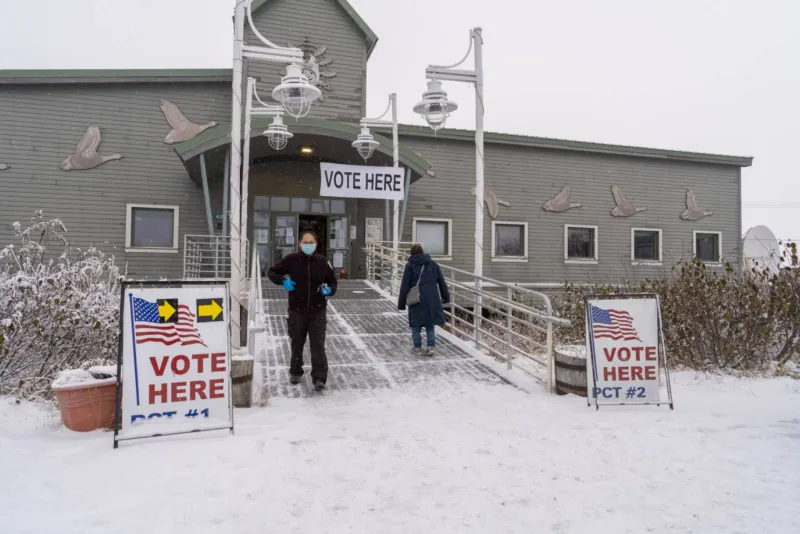
Photo: Alaska voters polling place snowy small town election day, via npr.brightspotcdn.com
Every election cycle, the national political class rediscovers Alaska the way a tourist discovers sourdough pancakes: with curiosity, a few assumptions, and a fundamental misunderstanding of the recipe.
The assumptions are familiar. Alaska is a red state—Republican presidential candidates usually win it comfortably. Therefore, the thinking goes, its voters can be reached with the same appeals that work in other red states. And every cycle, Alaska's electorate confounds that logic, splitting tickets, electing candidates from different parties to statewide office, and sending messages to both major parties that neither seems eager to receive.
The Issues That Refuse to Sort
What makes Alaska different is not a shortage of partisanship—there is plenty—but the fact that the state's defining issues do not sort neatly along national fault lines.
Consider firearms. Alaskan support for gun rights is among the strongest in the nation, cutting across party lines in ways that would startle a consultant from the suburbs of Washington, D.C. Many of the same voters, however, hold deeply held views about land access, subsistence hunting, and the public's right to fish and game—positions that put them at odds with some of the industries and landowners their party usually defends.
Consider privacy. A state with a long libertarian streak has repeatedly voted to limit government intrusion, from data privacy protections to skepticism of surveillance. That instinct binds rural conservatives and urban progressives in coalition more often than either party's platform acknowledges.
Consider federal overreach. Alaskans of every affiliation have a finely tuned allergy to decisions made in Washington about Alaska's land, water, and resources. It is one of the few sentiments that unites the state's congressional delegation with its most progressive village councils.
Why the Consultants Keep Missing
The misreading stems from a category error. National politics assumes ideology is the primary lens through which voters see the world. In Alaska, place is often the primary lens. A voter's position on a development project may depend less on party than on whether the project threatens a salmon stream they have fished for thirty years.
This is why Alaska's elections have rewarded candidates who are hard to categorize: figures who can plausibly promise to fight both their own party's establishment and the federal government, who talk about resources and privacy and local control in the same breath. The state's experiment with open primaries and ranked-choice voting did not create this independence—it gave it a mechanism.
A Preview of the National Future
It is tempting to treat Alaska as an outlier, and in demographics and geography, it is. But in political behavior, it may simply be early. As Americans increasingly describe themselves as independent, as ticket-splitting returns in swing states, as voters demand results over rhetoric, Alaska's contrarian streak looks less like an anomaly and more like a forecast.
The lesson Alaska offers is not that partisanship is dead—it is not, here or anywhere. It is that place-based loyalties can outrun party loyalty when the two conflict. In a state where a wrong decision about fish, land, or energy is felt personally and immediately, voters have never had the luxury of pure ideology.
The rest of the country, if it is paying attention, might learn something from an electorate that insists on being promised competence, respect, and a say in its own future—whatever letter follows a candidate's name.