Ground Zero: How Melting Permafrost Is Turning Alaska's Infrastructure Into a Fiscal Time Bomb
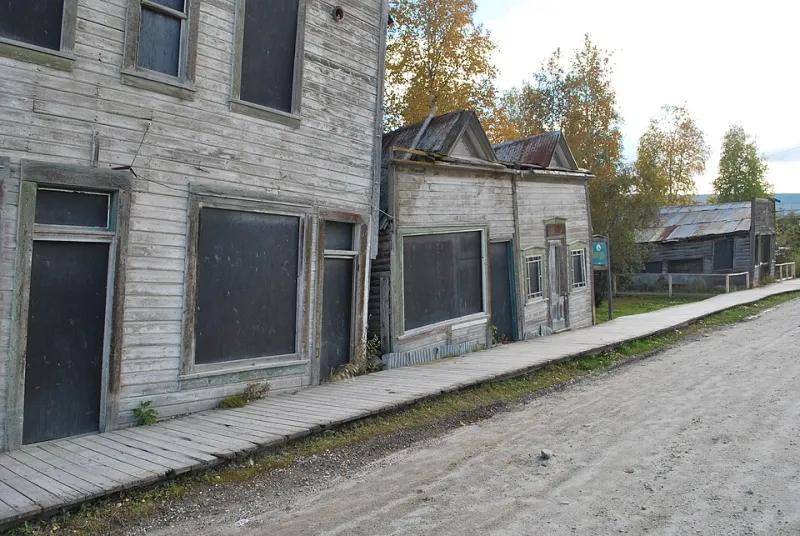
Photo: George Dean, CC BY-SA 3.0, via Wikimedia Commons
In Bethel, a water main ruptured last winter not because of aging pipes or poor maintenance, but because the frozen ground that had cradled those pipes for decades had quietly shifted beneath them. In Fairbanks, a stretch of residential road that cost the borough hundreds of thousands of dollars to repair in 2019 is already showing signs of renewed subsidence. In Newtok and Shishmaref, the conversation has moved past repair entirely—the question is no longer how to fix what is sinking, but where to move what remains standing.
These are not isolated incidents. They are dispatches from a slow-motion fiscal emergency unfolding across Alaska, one that state budget writers and municipal finance officers are only beginning to fully quantify—and one that is rapidly becoming impossible to ignore.
The Scale of the Problem
Permafrost underlies roughly eighty-five percent of Alaska's land mass. For most of the state's modern history, that frozen ground served as a reliable foundation—stable, predictable, and largely invisible to the people whose homes, roads, and pipelines rested upon it. That stability is eroding. Average ground temperatures across interior and western Alaska have risen measurably over the past four decades, and the consequences are written into the landscape in the form of thaw lakes, slumping hillsides, and infrastructure that no longer sits level.
The University of Alaska Fairbanks has estimated that permafrost degradation could cost the state between $3.6 billion and $6.1 billion in infrastructure damages through 2080 under moderate warming scenarios. Under more aggressive projections, that figure climbs higher. What makes those numbers particularly sobering is that they do not represent the cost of building new infrastructure—they represent the cost of simply maintaining what already exists.
For a state that has spent the better part of a decade navigating structural budget deficits and debating the future of its Permanent Fund, those figures land with particular weight.
Communities on the Front Line
The burden is not distributed evenly. Rural and remote communities—many of them predominantly Alaska Native—face the steepest challenges, in part because their infrastructure was often built with fewer resources to begin with, and in part because they sit on some of the most thermally sensitive ground in the state.
In the Yukon-Kuskokwim Delta, dozens of villages are contending with failing boardwalks, compromised fuel storage facilities, and water and sanitation systems that were never engineered for a warming climate. The cost of repairing or relocating these systems frequently exceeds what small community governments can absorb, even with federal assistance. Grant cycles are slow, matching fund requirements are steep, and the damage does not wait for the paperwork to clear.
Fairbanks North Star Borough presents a different but equally instructive case. As the state's second-largest population center, Fairbanks sits atop discontinuous permafrost—ground that is neither uniformly frozen nor uniformly thawing, but patchwork in ways that make engineering decisions enormously complicated. Borough officials have watched road maintenance costs climb year over year, not because of increased traffic loads, but because the subgrade beneath certain corridors is becoming less reliable. Decisions about which roads to prioritize, which neighborhoods to invest in, and which infrastructure to simply allow to degrade are already being made, often without explicit public acknowledgment of the climate calculus driving them.
The Political Arithmetic of Thaw
What makes permafrost degradation particularly vexing as a policy matter is that it does not fit neatly into existing budget categories or political frameworks. It is simultaneously a climate issue, an infrastructure issue, a rural equity issue, and a fiscal sustainability issue—and it tends to fall between the jurisdictional cracks of agencies and legislative committees that were not designed to address it holistically.
At the state level, the Alaska Department of Transportation and Public Facilities has begun incorporating permafrost vulnerability assessments into certain project planning processes, and the Department of Environmental Conservation has engaged with the infrastructure implications for rural water and sanitation. But coordination between agencies remains inconsistent, and there is no unified state strategy for managing permafrost-related infrastructure risk across sectors.
The political battles that have begun to emerge are predictable in outline if not always in specifics. Rural legislators argue that the state has an obligation to fund infrastructure stabilization and relocation for communities that contributed to Alaska's resource wealth but received comparatively little in return. Urban legislators, representing constituents who face their own infrastructure pressures, are reluctant to commit to open-ended rural infrastructure commitments at a time when the state's fiscal position remains precarious. Federal funding—through the Infrastructure Investment and Jobs Act and targeted programs for climate-affected communities—has provided some relief, but federal dollars come with conditions, timelines, and matching requirements that not every community can meet.
Underlying all of these debates is a deeper question that Alaska has not yet answered publicly: when the cost of maintaining infrastructure in a particular location exceeds any reasonable long-term benefit, who decides that the location should be abandoned, and who bears the cost of that decision?
A Reckoning That Cannot Be Deferred
There is a temptation, in both Juneau and Washington, to treat permafrost infrastructure costs as a future problem—something to be addressed when the damage becomes undeniable, funded by grants not yet secured, and managed by plans not yet written. That temptation is understandable, given the scale of competing priorities and the difficulty of mobilizing political will around a crisis that unfolds in increments rather than in a single dramatic event.
But the communities already living with buckling roads, tilting foundations, and compromised water systems do not have the luxury of deferral. For them, the reckoning has already arrived. The question is whether Alaska's political institutions will engage with it seriously—through honest fiscal planning, equitable distribution of costs and resources, and a willingness to make difficult choices transparently—or whether the state will continue to absorb the damage piecemeal, leaving the heaviest burdens on the communities least equipped to carry them.
Alaska has navigated hard fiscal terrain before. The state has rebuilt its budget frameworks, renegotiated its relationship with resource revenues, and found ways to sustain services through cycles of boom and contraction. The permafrost crisis demands that same capacity for clear-eyed reckoning—applied not to a revenue shortfall, but to the ground beneath our feet.
The longer that reckoning is postponed, the more expensive and more politically fraught it becomes. For Alaskans who live and work in affected communities, postponement is not a neutral choice. It is a choice that has already begun to cost them.