Crumbling Beneath Our Feet: Who Bears the Cost When Alaska's Ground Gives Way
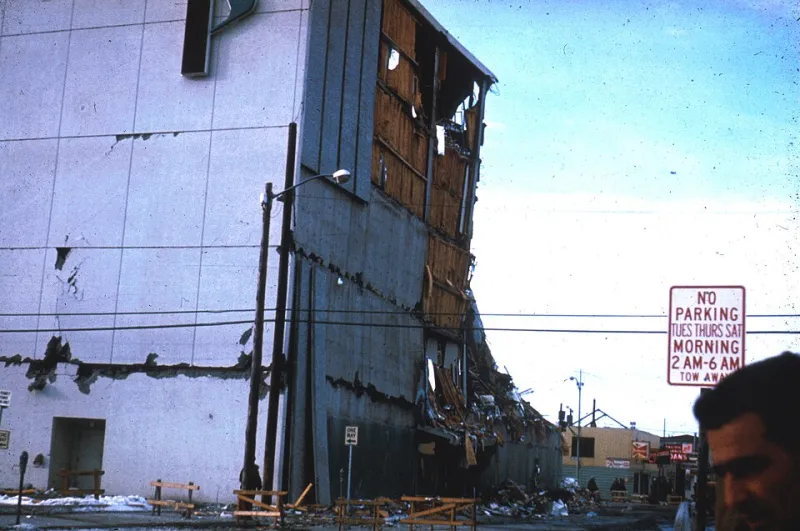
Photo: Unknown authorUnknown author, Public domain, via Wikimedia Commons
A Crisis Measured in Cracked Foundations and Emptied Budgets
In Bethel, municipal engineers have grown accustomed to re-leveling the same stretches of road every few years. In Fairbanks, homeowners watch their foundations shift incrementally, season by season, as the frozen soil beneath them softens. In dozens of smaller communities scattered across the Interior and the Arctic Slope, water and sewer lines installed decades ago now crack and separate as the ground beneath them loses its structural integrity.
This is not a distant, hypothetical consequence of a warming planet. It is a present-day fiscal emergency unfolding in slow motion across Alaska—one that is quietly consuming local budgets, destabilizing property values, and forcing municipal leaders into impossible choices between maintaining essential services and bracing for the next wave of climate-driven damage.
Permafrost, the layer of permanently frozen ground that underlies roughly 85 percent of Alaska's landmass, has served as a de facto building material for generations. Roads were graded atop it. Pilings were driven into it. Entire neighborhoods were constructed with the assumption that the ground, whatever else might change, would remain frozen. That assumption is no longer reliable.
The Numbers Behind the Damage
The scope of the problem is difficult to overstate. A 2019 study published in the journal Nature Communications estimated that permafrost thaw could place roughly $5.5 billion worth of Alaska's public infrastructure at high risk by mid-century under moderate warming scenarios. The University of Alaska Fairbanks has documented accelerating ground subsidence in communities from Nome to Utqiaġvik. The Alaska Department of Transportation has acknowledged that permafrost degradation is among the most significant long-term threats to the state's road network.
Yet these figures, alarming as they are, represent projections. The immediate, on-the-ground reality is already expensive enough. The Municipality of Anchorage, the Fairbanks North Star Borough, and smaller regional hubs like Kotzebue and Dillingham have each reported rising maintenance costs tied directly to ground instability. For smaller communities operating on thin margins—villages where the entire annual budget might not exceed a few million dollars—a single infrastructure failure can consume a substantial portion of available funds.
What makes the fiscal picture particularly difficult is that permafrost damage rarely presents as a single catastrophic event. It accumulates. A road that costs $200,000 to repair this year may require another intervention three years hence. A building that needs foundation reinforcement today may need full replacement within a decade. Local governments are essentially paying recurring costs for a problem that grows more expensive the longer it goes unaddressed.
Federal Promises and the Gap Between Rhetoric and Resources
Washington has not been entirely silent on the matter. The Infrastructure Investment and Jobs Act, signed into law in 2021, directed significant funding toward climate resilience broadly and included provisions relevant to Alaska. The Army Corps of Engineers has ongoing programs addressing erosion and flooding in coastal communities. The Department of Housing and Urban Development has administered relocation planning grants for villages facing existential threats.
But advocates and local officials argue that the scale of available federal support remains dramatically mismatched with the scale of the problem. Grant programs are often competitive, requiring communities to demonstrate need, develop detailed project plans, and navigate bureaucratic processes that smaller municipalities lack the administrative capacity to manage effectively. Funding that does flow tends to target the most acute crises—communities facing imminent coastal erosion, for instance—rather than the slower, diffuse damage that permafrost thaw inflicts across a broader geography.
There is also the matter of eligibility. Federal infrastructure programs frequently require local cost-sharing arrangements. For a village of 300 residents with a limited tax base, even a modest matching requirement can render an otherwise accessible grant effectively unreachable. The result is a paradox familiar to many Alaskan communities: the places most vulnerable to permafrost damage are often the least equipped, financially, to qualify for the programs designed to help them.
Private Property, Public Problem
The complications do not stop at the municipal line. Private property owners in Alaska face a parallel crisis with even fewer institutional supports. Homeowners whose foundations are sinking, whose septic systems are failing, or whose driveways have become impassable have limited recourse. Standard homeowners' insurance policies typically exclude damage caused by ground movement. Federal flood insurance, administered through FEMA's National Flood Insurance Program, does not cover permafrost-related losses.
This leaves individual Alaskans to absorb costs that can run from tens of thousands to hundreds of thousands of dollars—for damage they did not cause and, in many cases, could not have anticipated when they purchased their properties. The legal framework governing liability is similarly underdeveloped. Courts have not established clear precedent for who bears responsibility when permafrost thaw damages shared infrastructure or adjacent private property. State statutes offer limited guidance. The result is a legal gray zone in which affected residents frequently have no viable path to compensation.
Hard Choices in Local Budget Rooms
For elected officials at the borough and municipal level, the permafrost problem is not an abstraction—it arrives in the form of line items, deferred maintenance schedules, and conversations about what gets cut when repair costs escalate unexpectedly.
Some communities have begun incorporating climate adaptation into their capital improvement planning, setting aside reserves for infrastructure reinforcement or exploring thermosyphon systems and other engineering interventions designed to stabilize frozen ground. These are prudent strategies, but they are expensive ones, and they compete directly with other urgent priorities: public safety, education, utility operations, and the basic services that residents depend on year-round.
The broader policy question—one that Alaska's congressional delegation, state legislature, and municipal associations have engaged with to varying degrees—is whether the current framework for distributing climate adaptation costs is equitable or sustainable. Alaska contributes a fraction of the greenhouse gas emissions driving the warming that is destabilizing its ground. Its communities are absorbing costs that are, in a meaningful sense, the product of decisions made far beyond their borders.
Toward a Framework That Reflects Alaska's Reality
Addressing this challenge will require more than incremental adjustments to existing grant programs. It will require a frank acknowledgment, at the federal and state levels, that Alaska's permafrost crisis is a distinct category of infrastructure emergency—one that demands dedicated funding streams, streamlined application processes, and liability frameworks that reflect the actual distribution of risk.
It will also require sustained engagement from Alaska's own policymakers. The state legislature has the capacity to establish adaptation funds, revise building codes to account for changing ground conditions, and create legal structures that give affected property owners clearer rights. Progress on these fronts has been uneven.
What is not in question is the urgency. The ground beneath Alaska's communities is changing, and the costs of that change are already being paid—by municipal budgets, by private homeowners, and by the essential workers and families who depend on infrastructure that is becoming less reliable with each passing year. The longer the question of responsibility goes unanswered, the more expensive the eventual reckoning will be.