Northern Exposure: The Tech Industry's Turn Toward Alaska and Whether Alaskans Will Share the Gains

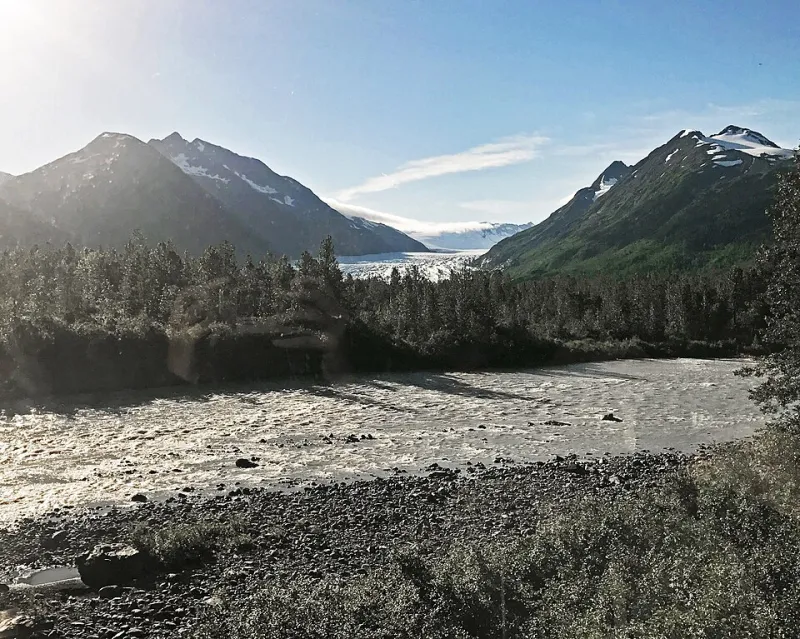
Photo: Asurnipal, CC BY-SA 4.0, via Wikimedia Commons
For decades, Alaska's economic identity has been anchored to oil, fishing, and tourism — industries as old as statehood itself. But a quieter transformation is underway, one measured not in barrels or pounds of salmon, but in fiber-optic cables, data center cooling requirements, and the growing appetite among technology firms for what Alaska has that nowhere else can offer: cold air, open land, and an increasingly connected frontier.
The question Alaskans should be asking is not simply whether the tech industry is arriving. It is whether, when it does, the state will be ready to ensure that what follows actually serves the people who live here.
What Is Drawing Tech Companies North
The appeal Alaska holds for certain segments of the technology sector is neither accidental nor abstract. Data centers — the physical backbone of cloud computing, artificial intelligence, and digital communications — require enormous amounts of electricity and even more substantial cooling infrastructure. In most of the continental United States, keeping servers at operating temperature is an expensive, energy-intensive proposition. In Alaska, ambient temperatures do much of that work for free.
Beyond cooling economics, Alaska's position along the Arctic corridor makes it strategically significant for subsea cable routing between North America and Asia. The ALASKA UNITED and the more recent TERRA SW fiber projects have already demonstrated that the state can serve as a critical node in global data transmission. As demand for low-latency transpacific connectivity grows, Alaska's geography becomes a genuine competitive asset rather than merely a curiosity.
Federal investments in rural broadband, accelerated in part by post-pandemic infrastructure legislation, have begun to extend high-speed internet access to communities that were previously operating on satellite connections at best. This expansion does not just benefit residents checking email — it fundamentally changes what kinds of businesses can operate here and what kinds of workers can do their jobs here.
The Remote Work Realignment
The normalization of remote work has had a measurable effect on Alaska's labor market conversation. Professionals in software development, cybersecurity, data analysis, and digital marketing no longer need to leave the state to access competitive salaries. A software engineer working for a Seattle-based firm can, in principle, live in Juneau or Fairbanks and maintain the same productivity — provided the connectivity is there.
This represents a structural shift that Alaska's economic planners have been slow to capitalize on. States like Montana and Vermont moved quickly to market themselves as remote-work destinations, offering relocation incentives and streamlined business registration processes. Alaska, with arguably stronger natural appeal and a well-established Permanent Fund Dividend as a form of baseline income support, has been comparatively late to frame itself in those terms.
Some private initiatives have begun to fill the gap. The Anchorage Economic Development Corporation has made technology sector recruitment a stated priority, and the University of Alaska system has expanded its computer science and cybersecurity offerings in recognition of where workforce demand is heading. These are meaningful steps. They are not, however, a comprehensive strategy.
The Risk of Extraction Without Retention
Alaska has a long and instructive history with industries that arrived promising prosperity and departed leaving comparatively little behind. The concern that the technology sector could follow a similar pattern is not paranoia — it is pattern recognition.
When a large corporation establishes a data center in Alaska, the local economic benefit depends almost entirely on the specifics of how that facility is structured. A largely automated operation staffed by a small team of highly specialized technicians imported from Outside provides minimal employment for Alaskans. It may consume locally generated electricity, potentially straining a grid that rural communities depend on, while the tax revenue it generates flows through structures optimized for the company's benefit rather than the state's.
Contrast that model with a scenario in which Alaska actively negotiates for local hiring requirements, invests in workforce training pipelines through the university system and community colleges, and structures tax incentives to reward companies that source local contractors and vendors. The difference in community impact between these two approaches is substantial — and it is determined by policy choices made before the companies arrive, not after.
What Alaskans Should Demand
The state legislature and the Governor's office have a narrow but genuine window to shape how the technology sector's interest in Alaska is channeled. Several priorities deserve immediate attention.
First, any tax incentive package offered to technology firms should include enforceable local employment benchmarks. Incentives without accountability are gifts, not investments.
Second, the expansion of broadband infrastructure must be treated as a public utility priority, not simply a federal grant opportunity. Rural Alaska connectivity is the prerequisite for rural Alaskans to participate in the digital economy on their own terms.
Third, Alaska's workforce development apparatus — the university system, vocational programs, and tribal workforce initiatives — needs dedicated funding to train Alaskans for the specific technical roles that this sector requires. A data center that cannot find qualified Alaskans to hire will import its workforce. That is a policy failure, not an inevitability.
Finally, the state should establish a transparent review process for large technology infrastructure projects, one that includes meaningful public comment periods and requires applicants to demonstrate community benefit alongside financial projections.
The Opportunity Is Real — But So Is the Risk
Alaska's moment in the technology industry's field of vision is genuine. The infrastructure fundamentals are sound, the geographic advantages are durable, and the broader economic trends are moving in a direction that could benefit the state meaningfully.
But advantage is not destiny. Without deliberate policy architecture designed to ensure that Alaskans are the primary beneficiaries of this interest — not merely the hosts of it — the state risks repeating a familiar story: Outside capital extracts value from Alaska's unique assets, and Alaskans are left with disrupted communities and modest royalty checks.
The technology sector's northward gaze is an opportunity worth welcoming. It is also one worth approaching with clear eyes and firm expectations. Alaska has enough experience with industries that promised more than they delivered to know that the terms of engagement matter as much as the invitation itself.