The Thaw That Changes Everything: Alaska's Freshwater Future Is at Stake and the Clock Is Running
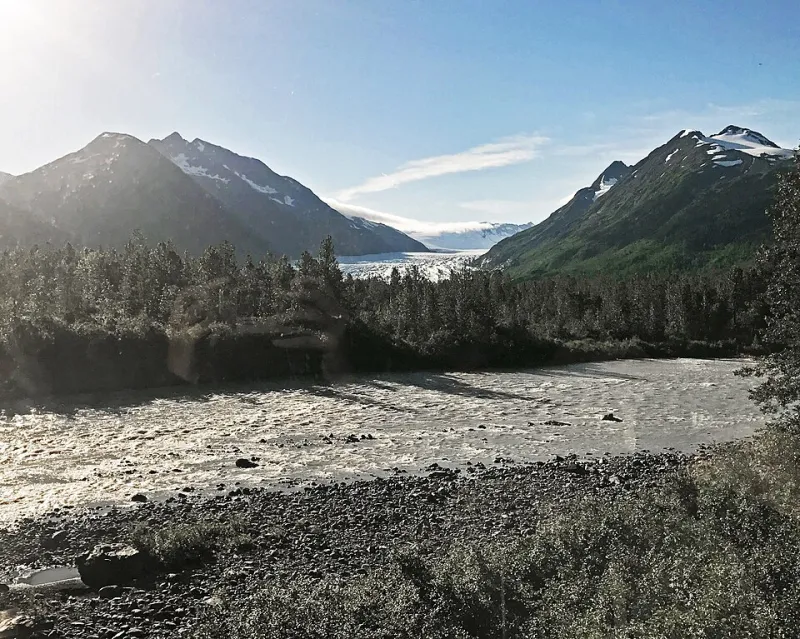
Photo: James St. John, CC BY 2.0, via Wikimedia Commons
Alaska is, by nearly every measure, a water-rich state. It contains roughly 40 percent of the nation's surface water, more than three million lakes, an estimated 12,000 rivers and streams, and glaciers that dwarf anything found elsewhere in North America. For most of Alaska's history, water has been treated as an inexhaustible given — the kind of resource so abundant that formal protection seemed almost beside the point.
That assumption is now being tested in ways that should concern every Alaskan, from the subsistence fisherman on the Kuskokwim to the municipal water manager in Anchorage to the Indigenous elder watching a glacier that has fed her community's watershed for generations shrink visibly year by year.
Glaciers Are Not Forever
The scientific record on Alaska's glacial retreat is unambiguous and accelerating. The state's glaciers collectively lose an estimated 75 billion tons of ice annually, a figure that has increased significantly over the past two decades. The Juneau Icefield, which feeds dozens of rivers and streams across Southeast Alaska, has experienced some of the most dramatic documented retreat in the Western Hemisphere.
For many Alaskan communities, glacial meltwater is not an abstract environmental statistic — it is the source of municipal water supply, the regulator of river flow timing, and the foundation of salmon habitat. As glaciers diminish, the seasonal hydrology that Alaska's ecosystems and communities have adapted to over centuries is being restructured. Rivers that once ran cold and steady through summer are showing increased variability. Some are running lower earlier in the season. Others are flooding with unusual intensity as ice dams destabilize.
The long-term trajectory is toward reduced glacial contribution to freshwater systems — not immediately, but within a timeframe that current infrastructure planning must account for. Communities that do not begin adapting their water sourcing strategies now will face significantly harder choices in twenty years.
Competing Claims on a Shrinking Resource
Even as the overall freshwater supply faces long-term pressure from glacial loss, the near-term competition for Alaska's water is intensifying from multiple directions simultaneously.
The mining sector, one of Alaska's most significant economic drivers, requires substantial water for ore processing and has a complex and contested history with watershed impacts across the state. The proposed Pebble Mine at the headwaters of Bristol Bay remains the most high-profile example, but it is far from the only project raising water access and contamination concerns. Smaller operations across Interior and Southwest Alaska have generated ongoing disputes with subsistence users and tribal governments over stream flow rights and runoff management.
Agricultural interests, while historically modest in Alaska, are expanding as longer growing seasons and warming temperatures make farming in Interior Alaska more viable. This emerging sector will require irrigation water from rivers and aquifers that are already subject to competing demands. Unlike the Lower 48, Alaska has not yet developed the kind of comprehensive water rights adjudication framework that would allow these competing claims to be resolved through predictable legal processes.
Most critically, Indigenous communities throughout the state rely on freshwater systems not merely as utilities but as the ecological foundation of subsistence lifestyles that are legally protected and culturally irreplaceable. When water quality degrades or flow patterns shift, the impact is not limited to inconvenience — it threatens the viability of ways of life that have sustained Alaska Native peoples for thousands of years and that remain central to the identities of hundreds of communities today.
A Policy Framework That Has Not Kept Pace
Alaska's water governance structure was largely designed for a different era and a different set of pressures. The Alaska Department of Natural Resources oversees water appropriation through a permit system, but that system was built around the assumption of abundance and does not yet incorporate the kind of forward-looking scarcity planning that climate projections now demand.
There is no comprehensive statewide freshwater management plan. Monitoring of groundwater levels in rural communities is inconsistent and in many areas entirely absent. The legal framework for resolving conflicts between industrial water users and subsistence-dependent communities remains underdeveloped, leaving disputes to be resolved through litigation that is slow, expensive, and typically disadvantages the communities with the fewest resources.
At the federal level, the Environmental Protection Agency and the Army Corps of Engineers maintain overlapping jurisdiction over wetlands and waterways that is itself the subject of ongoing legal uncertainty following recent Supreme Court decisions narrowing the scope of federal water protections. For Alaska, where wetlands are both extraordinarily extensive and ecologically critical, these jurisdictional reductions carry consequences that state regulators have not yet fully mapped.
What Is at Risk If Alaska Waits
The pattern that Alaskans have reason to fear is not dramatic or sudden. It is incremental. It is a series of individual water use permits approved without cumulative impact assessment. It is a mining operation that gradually alters the sediment load of a river system. It is a municipal aquifer that begins showing signs of depletion without any monitoring system in place to catch the early warning. It is Outside agricultural investors purchasing land rights that carry implicit water access claims before Alaskans have established the legal architecture to protect community interests.
By the time the consequences are visible and undeniable, the decisions that created them will have already been made — and reversing them will be far more difficult than preventing them.
What Alaskans Need to Demand Now
Protecting Alaska's freshwater future requires action on several fronts before crisis conditions force reactive decision-making.
The state legislature should authorize and fund a comprehensive freshwater inventory and monitoring system, with particular attention to groundwater in rural communities and glacially-fed watersheds showing documented retreat. Without baseline data, there is no way to detect degradation until it is severe.
Alaska needs a formal water rights framework that explicitly accounts for subsistence use, tribal water rights, and the cumulative impacts of multiple industrial users drawing from shared watersheds. The current patchwork is inadequate for the level of competition that is coming.
Public access to water permitting data should be strengthened, with meaningful community comment processes for permits that affect subsistence users. Decisions made behind closed doors in Juneau or Washington, D.C. about Alaska's water should not come as surprises to the Alaskans who depend on those systems.
Finally, Alaska's congressional delegation should be pressing for federal investment in climate adaptation infrastructure specific to water systems — not as a partisan issue, but as a practical necessity for a state whose freshwater geography is being fundamentally altered by forces that are already in motion.
The Resource That Cannot Be Replaced
Oil can be replaced by alternative energy. Fish populations, given sufficient protection, can recover. But freshwater systems, once contaminated or structurally degraded, do not simply return to their prior state. The glaciers that are retreating today will not return within any planning horizon that current Alaskans will live to see.
Alaska's water is not just an environmental asset. It is the substrate on which the state's communities, cultures, and economies are built. The decisions made — or deferred — over the next decade will determine whether Alaskans retain meaningful control over that foundation, or whether they wake one day to find that others have quietly made those decisions on their behalf.