Ports of Call, Profits Adrift: Tracing the Cruise Dollar Through Alaska's Harbor Towns
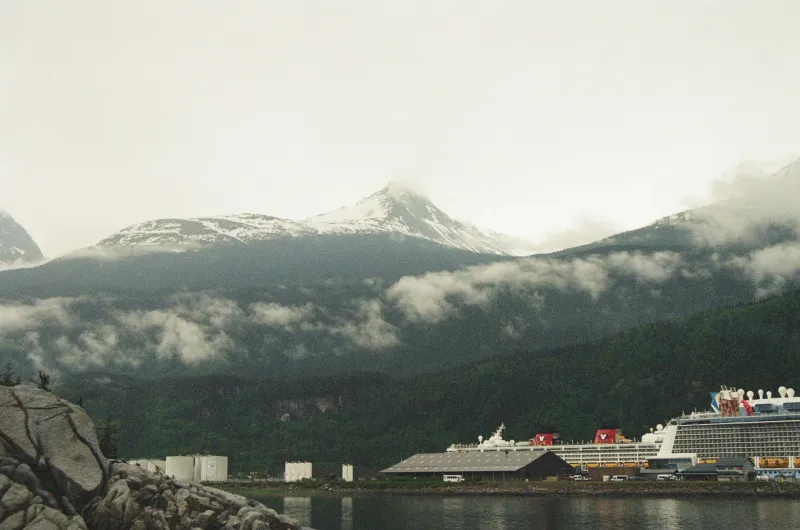
Every summer morning in Juneau, the horizon fills with hulls. Three, four, sometimes five large vessels slide up Gastineau Channel before breakfast, and by mid-morning the downtown corridor is thick with passengers. By late afternoon they are gone, the sidewalks swept clean, the storefronts shuttered until the next arrival.
That is the rhythm of Alaska's cruise economy: a compressed, highly engineered season that delivers well over a million visitors to a state with fewer than three-quarters of a million residents. Few in the port towns question that the ships bring money. The harder question — the one that has divided Southeast communities for two decades — is where that money comes to rest.
A Season That Sets the Town's Clock
Cruise travel is the largest single segment of Alaska's visitor industry. State tourism estimates have long held that roughly half of all summer visitors arrive by sea, and in Southeast communities such as Ketchikan, Skagway and Juneau the share runs far higher. In Skagway, a borough of about 1,100 year-round residents, daily passenger counts in peak weeks can exceed the local population several times over.
For businesses that cater to that flow — excursion operators, gift shops, tour bus companies, seafood counters — the season is a windfall compressed into roughly twenty weeks. For everyone else, it is a stretch of congestion, seasonal labor shortages and infrastructure strain that the property tax base rarely captures.
Who Books the Excursion, Who Keeps the Margin
The central fiscal fact of the cruise industry is that a large share of the passenger dollar is collected before the ship ever docks. Lines sell shore excursions directly to travelers, often months in advance, and the local operators who run those tours frequently work under contract to the vessel. The company books the sale; the Alaskan delivers the experience.
That arrangement is not inherently unfair. It gives small operators access to a global customer base they could never reach alone, and it smooths a business that would otherwise be entirely weather-dependent. But it does mean the headline figure for cruise-related spending overstates what actually stays in the state. Independent operators, locally owned retail and food businesses, and municipal port operations capture a much smaller slice than the gross numbers suggest.
Port revenue is the most visible local benefit. Alaska levies a commercial passenger vessel excise tax of roughly $34.50 per berth, a portion of which is directed to port communities, and several municipalities add their own per-passenger fees. Those dollars fund docks, staging areas, and in some towns, direct services. Whether they cover the full municipal cost of hosting a million visitors — police, transit, water, waste, road wear — has never been settled with a clean public accounting.
The Bill Nobody Itemizes
Ask a city finance director what a cruise passenger costs the town, and the honest answer is usually that nobody knows. The costs are real but diffuse: extra seasonal staffing at the police department, more frequent trash collection downtown, wear on streets not built for tour bus traffic, and the quieter expense of a downtown economy reshaped around a twenty-week window rather than a twelve-month one.
There is also the environmental ledger, harder to price and harder still to ignore. Wastewater discharge, emissions from ships at anchor, and cumulative pressure on trails, harbors and marine habitat fall on communities that hold little authority over vessels flagged elsewhere and regulated largely at the federal and international level.
Caps, Fees, and the Limits of Local Control
The policy menu available to Alaska municipalities is narrower than residents often assume. Sailing schedules are a private commercial matter. Ports can influence volume through berth allocation and pricing, but they cannot simply will a smaller season into being.
What they can do is price access and attach conditions. Visitor fees generate revenue but are easily absorbed into a passenger's ticket without changing behavior. Local hiring requirements on excursion contracts are difficult to enforce across a workforce that is itself seasonal and often imported. Passenger caps, the bluntest instrument, are the most effective at protecting quality of life — and the most threatening to the businesses that depend on volume. Juneau's recent municipal fight over restricting Saturday ship traffic showed how sharply those interests diverge. The measure failed, but the underlying tension did not, and similar debates remain live in Ketchikan and Sitka.
What a Local Dividend Would Look Like
A more durable path may lie less in limiting ships than in capturing value. Three ideas recur across port communities.
First, tie port fees to measurable municipal cost, with an annual public accounting of what the industry contributes and what hosting it consumes. Data alone would change the tenor of the argument.
Second, use berth priority as leverage for local procurement — giving scheduling preference to operators who hire Alaskans, source goods locally and post performance bonds.
Third, formalize community benefit agreements, in which lines contribute to a dedicated pool for harbor infrastructure, seasonal housing and workforce training.
None of these is radical. All require something Alaska has struggled to produce on this issue: reliable numbers and a shared set of expectations between the docks and the town.
The ships will keep coming. The question for Alaskans is not whether to welcome them, but whether the terms of the welcome are written in Juneau and Ketchikan — or somewhere else entirely.